
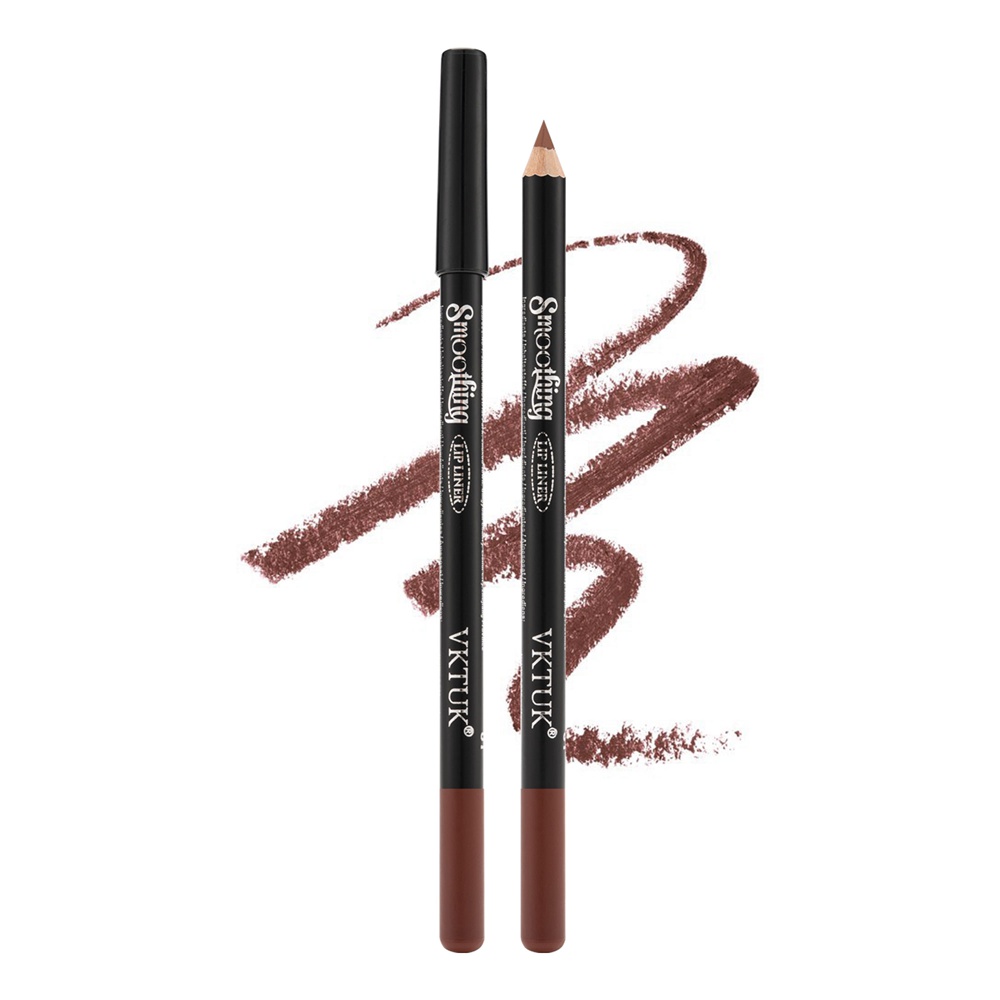
For a lip liner cap enquiry, ask the supplier to identify the exact cap and pencil barrel together, mark the intended closed position, and provide the reference that the buyer will approve. A catalogue photograph can help identify the appearance of a product, but it does not establish cap compatibility, closing force, airtightness or durability. Keep those questions separate from the appearance reference and leave unconfirmed requirements open.
A buying team may receive a cap photograph in one message and a pencil quotation in another. Both can look relevant while referring to different versions. The practical task is to connect the proposed cap, the quoted pencil and the supplier’s explanation in one record. This gives purchasing and sample reviewers a shared reference without turning a photograph into a performance promise.
Start with the quoted pencil identity
Jling Cosmetics lists a Black Body Wood Lip Liner in its catalogue. Use the actual product page as the starting reference: https://jlingcosmetics.com/product/black-body-wood-lip-liner/ . Ask the supplier to confirm which quoted version the discussion concerns. The catalogue name identifies the enquiry subject; it does not confirm every component detail of a future order.
Record the supplier’s item reference, the quotation revision and the image or sample being discussed. If the supplier uses a different internal name, retain both names with an explicit link. Avoid replacing the original page reference with a cropped photograph alone. A crop can remove the context that distinguishes a cap from another similar-looking part.
The selected catalogue image is useful for discussing visible cap and barrel appearance. It is not a drawing of the connection between them. Ask the supplier to mark that connection on a relevant reference rather than describing a hidden feature as though the photograph had already established it.
Define what the closure reference should show
Request a supplier-marked view of the proposed cap with the corresponding pencil. The response should identify the intended closed position and explain any visible reference point the supplier wants the buyer to use. Where a feature cannot be seen, ask for an explanation or a more suitable reference instead of guessing its construction.
A side view, an annotated image or an identified sample may answer different questions. A side view can show the appearance of the assembled product; an annotation can explain what a line or edge means; a sample gives the parties a physical reference to discuss. None should automatically substitute for the others. Ask which evidence supports each answer and whether it applies to the quoted version.
This is a documentation request, not an instruction to carry out an improvised force test. If the buyer has a separate technical requirement, identify it as an open requirement for discussion. Do not add a numerical acceptance value simply because the record has an empty field.
Keep the cap and barrel linked in the record
Record field | Buyer entry | Supplier response needed
Quoted product | Catalogue link and quotation revision | Exact version covered by the answer
Proposed cap | Image or sample reference | Identification of the cap being offered
Corresponding barrel | Same order-line reference | Confirmation of the intended matching pencil
Closed-position reference | Requested marked view | Explanation of the intended appearance when closed
Evidence status | Pending or reviewed | Reference date and any remaining limitation
Separate requirement | Clearly labelled open question | Proposed evidence and scope, if available
Keep an unanswered field visibly pending. A cap identified in a product photograph is not yet a confirmed replacement part. Likewise, a response about one assembled sample does not necessarily cover every colour or version listed elsewhere in a quotation. Ask the supplier to state the scope directly.
Separate colour approval from closure approval
Cap colour can serve as a visual identification cue, but it is a different purchase decision from the intended cap-to-barrel reference. A buyer can approve a colour image while still waiting for the supplier to identify the matching component. Use separate status fields so that one approval does not silently close the other.
For example, a colour review may refer to a labelled photograph, while the closure discussion refers to a supplier-marked assembled sample. Retain both references and their purposes. If the supplier changes the cap appearance during development, ask whether the earlier assembly reference still applies. Do not assume that a visually similar alternative has the same compatibility.
An order amendment should name the changed reference and the unresolved question. That is more useful than a general instruction to use the usual cap, especially when several people have exchanged images in separate messages.
Describe the limits of each answer
A statement that a cap is the intended part for a particular pencil should remain attached to that identified version. It is not proof of airtightness, retention force, repeated-use durability, child safety or protection of the cosmetic core. Those are different claims that require their own stated scope and supporting evidence.
If such a claim matters to the buying decision, ask the supplier what evidence is available and which item it covers. Do not convert a general marketing description into a measured result. This guide does not provide a safety certification decision or a test procedure; its purpose is to make the commercial enquiry precise enough for the parties to identify what remains unconfirmed.
Keep changes visible through sample review
When a sample arrives, link its identifying reference to the supplier response. Review whether the supplied item is the one discussed, and record any difference as an observation for clarification. Avoid rewriting the supplier’s original statement to match a later sample. Keeping both records makes a revision easier to understand.
If the supplier proposes another cap, ask for a new reference and confirmation of the corresponding pencil. Record whether the proposal replaces or supplements the earlier version. Purchasing should be able to see which reference is current before the order line is approved, without interpreting an old message as blanket permission for substitutions.
Frequently asked questions
Can a product photograph prove that a replacement cap fits?
No. It can identify an appearance reference. Ask the supplier to identify the proposed replacement and the exact pencil it is intended to match. Leave compatibility unconfirmed until the parties have agreed on suitable evidence.
Does a marked closed-position image prove airtightness?
No. The image may explain the intended assembled appearance, but airtightness is a separate claim. Do not add it to an order specification solely from the position shown in a photograph.
What if the supplier provides a cap colour code only?
Retain the code for the colour discussion and request the missing cap-to-barrel reference separately. A colour identifier does not answer which component or quoted version the supplier means.
Should the buyer invent a force value to complete the record?
No. Mark the requirement as open and ask what information is available. An arbitrary value creates a requirement without an agreed basis and does not make the reference more reliable.
Send one traceable closure enquiry
Prepare the quotation reference, catalogue link, proposed cap image and a short list of unresolved questions before contacting Jling Cosmetics at https://jlingcosmetics.com/contact/ . Request a marked closure reference for the exact quoted pencil and ask the supplier to distinguish confirmed information from pending answers. Use the company’s related catalogue guidance at https://jlingcosmetics.com/blog/ for context, while keeping the supplier’s specific response as the order record.